
Colorado Ag Labor 60-hour Overtime Threshold Bill Moves On
March 28, 2026
Colorado Senators debated two competing agriculture overtime bills last week in a rare double-bill hearing. Assigned to the Senate Business, Labor and Technology Committee, the first bill was sponsored by committee chair Jessie Danielson, D- Wheat Ridge. Her bill, SB81, would have lowered the overtime threshold from 48 hours to 40. Danielson was the sponsor of the 2021 legislation she called the Farm Worker Bill of Rights.
Last year, Gov. Polis signed a bill to remedy one of the issues with that bill that allowed so-called service providers unfettered access to private property. The overtime provisions are the second major concern with the 2021 law now coming to a head.
The second bill debated was Sen. Robert Rodriguez’s SB 121, which seeks to raise the threshold to 60 hours.
Bill co-sponsor Senate Minority Leader Cleave Simpson, who farms 800 acres and raises cattle in Alamosa County, said he tries to illustrate to his fellow lawmakers that agriculture producers, particularly small operations, make every attempt to pay better than the minimum wage, often provide housing, transportation, cell phones, bonuses, and other things all in recognition of running it like a family operation.
“To broad brush the entire ag industry as industrial where employees show up and punch a time clock and work 8 hours is just a misrepresentation of reality,” Simpson said. “I don’t know how else to help my colleagues appreciate that but I’m certain that many of them understand the distinction so I’m confident the bill I’m on will pass the Senate.”
He said the bill isn’t about competing interests. He said farmers need a valued and respected workforce and they need profitable producers and an ag business to hire them.
Simpson offered a recent USDA publication listing Colorado as the leading the nation in farm losses due to factors including climate, input costs, and increased labor costs. He said those challenges are forcing producers to transition to less labor-intensive crops.
“Farmers will start producing crops that are less labor intensive,” he said. “And that’s happening, That’s not fear mongering. That’s happening. Mechanization will take over or, where they can, they’ll have somebody else and that worker will have to try to get another job. There’s evidence to demonstrate that’s all a reality.”
Simpson said the USDA study he referenced came out late in 2025 and indicates that Colorado lost 1.6 million acres since 2017.
“I think I was clear that there are a lot of factors that play into that, but the profitability of farms is one of those,” he said. “Pressures, climate, input costs…there’s lots of things driving that record setting pace for the number one position Colorado achieved. We have to do better. Helping farmers be profitable, not at the expense of labor but, again, in collaboration with labor and having a respected, dignified, compensated work force is part of the solution to keep economics from playing an ever bigger role in driving people out.”
Simpson said farming within limited water resources last year was difficult and required many circles be fallowed. This year, he said, it is approaching impossible. Simpson said he fears many states are on pace to exceed the drought of 2002, and said the drought conditions across the state, including the San Luis Valley, are straining an already fragile agriculture economy.
“It’s horrific,” he said. “I don’t know why I torture myself, but every day I look at the snow water equivalent index and this morning the Rio Grande is at 34%. The Arkansas, Rio Grande and Southwest are all at less than 40% and at this time of year, it’ll drop a point every day we don’t get snow.”
Simpson said he is confident that some of his shares from a mutual ditch company that diverts water from the Rio Grande will not come into priority this summer. That leaves him back to pumping ground water, something he has advocated against.
“I’ve advocated for and tried to reduce my dependence of pumping ground water but, how in the world does my farm survive with no surface water diversions?” he said.
That is particularly troubling, he said, when fuel and fertilizer costs are quickly increasing. With water districts paying farmers to fallow fields, he said he and many other growers will soon be forced to make decisions about their next crop.
“I’m trying not to be pessimistic and downtrodden, but conditions are just horrible in the Rio Grande Basin,” he said.
Rodriguez said he supported Danielson’s 2021 bill but said he recognizes now that it was well-intentioned but carried harmful unintentional consequences in the form of shrinking paychecks and workers leaving the state in search of more hours.
“This is not what any of us intended when we fought for extended labor protections,” he said. “If we care about protecting workers and supporting rural communities and keeping family farms in Colorado, we need policies that actually work.”
According to reporting by Marianne Goodland, Stacy Suniga of the Latino Coalition of Weld County spoke in favor of the bill. She offered the example of a 19-year-old woman working in harsh conditions, though she didn’t address the overtime issue at hand.
In her closing remarks before the failing vote, Danielson criticized the ag producers who have avoided paying overtime by decreasing hours, sarcastically calling them clever.
Sen. Nick Hinrichson, a Pueblo Democrat who also sits on the Senate Agriculture Committee, was the swing vote, as he has been this year on other bills that were potentially damaging to agriculture. He said Pueblo County, where he resides, has lost 54% of farms in the county and of the remaining operations, two thirds operated at a net loss last year.
Source: Rachel Gabel, The Fence Post Magazine
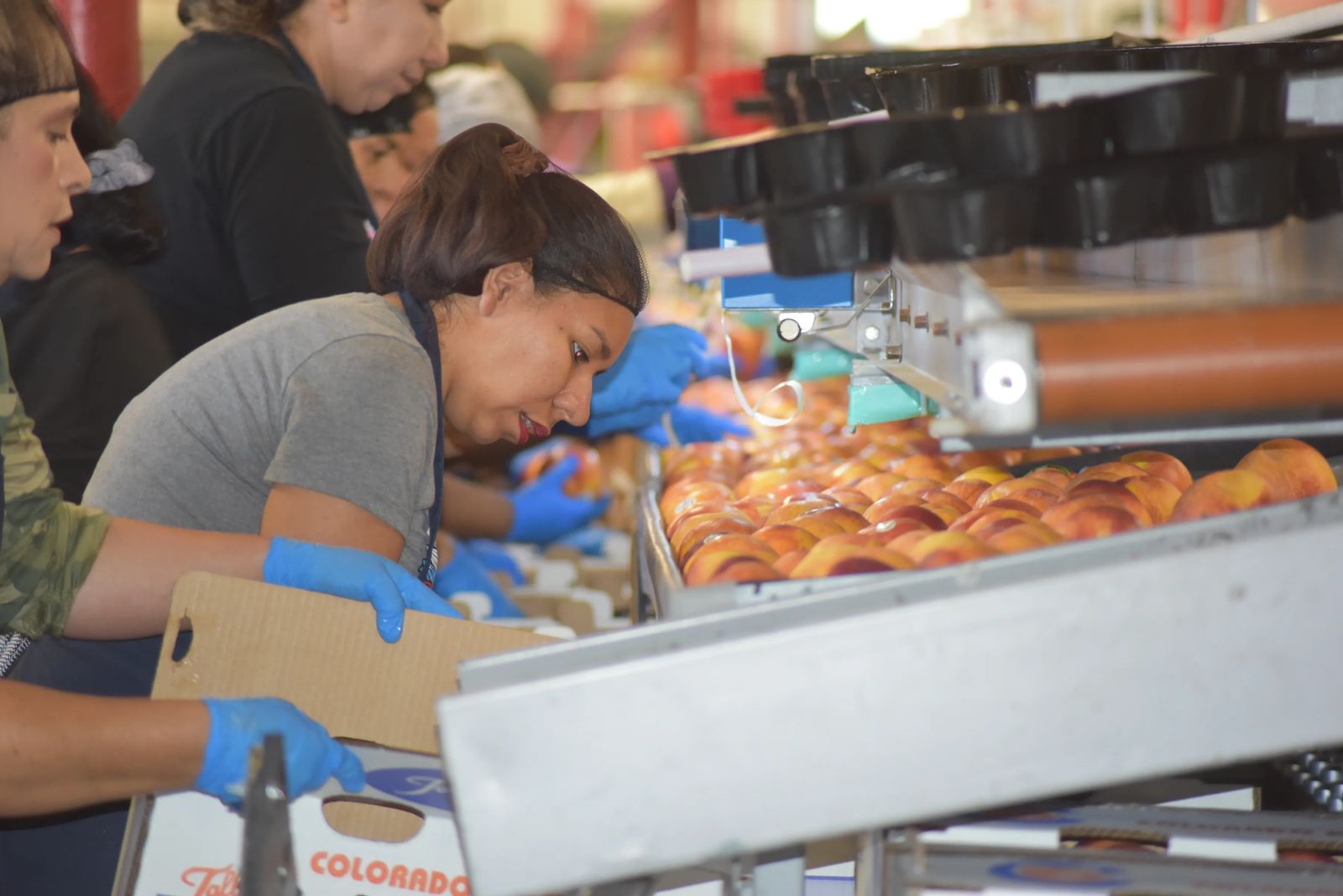
Photo: Workers pack peaches at Talbott Farms in Palisade, Colo. These particular workers are H-2A workers and these bills are state level bills. Photo By Rachel Gabel.


