.png?fit=outside&w=1200&h=630)
USDA Confirms New World Screwworm Detection in Texas Calf
June 3, 2026
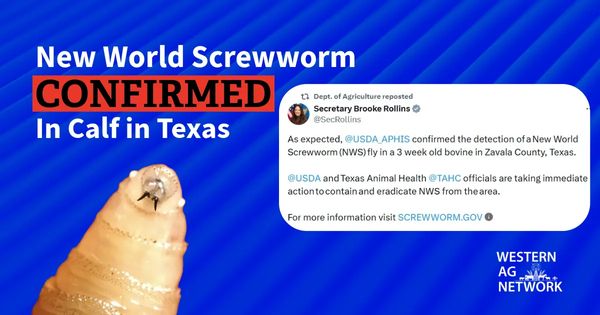
UPDATE 7:30 PM: USDA Confirms New World Screwworm Detection in Texas Calf
The U.S. Department of Agriculture's Animal and Plant Health Inspection Service (APHIS) has confirmed the detection of New World screwworm (NWS) in a calf in South Texas, marking the first confirmed U.S. detection as the pest continues moving north from Mexico.
The affected animal is a 3-week-old calf in Zavala County, Texas. According to USDA, larvae were identified in the calf's umbilical area. Officials say there have been no additional detections at this time.
Earlier Wednesday, USDA was testing samples collected from two calves near La Pryor, Texas. By Wednesday evening, APHIS confirmed the presence of New World screwworm larvae.
Immediate Response Underway
USDA and the Texas Animal Health Commission are taking immediate action to contain and eradicate the pest using strategies outlined in the New World Screwworm Response Playbook.
Response efforts include:
- Establishing a unified incident command team between USDA and the Texas Animal Health Commission.
- Creating a 20-kilometer infested zone around the detection site.
- Implementing quarantines, movement controls and increased surveillance within the affected area.
- Expediting sterile fly releases through ground-based release chambers.
- Continuing aerial releases of approximately 4 million sterile flies per week in the region.
- Increasing trapping efforts along the border and surrounding areas.
- Expanding surveillance and management efforts in wildlife populations.
- Conducting outreach to livestock producers and local residents.
USDA's National Veterinary Stockpile also stands ready to provide treatments, equipment and logistical support as needed.
WATCH
USDA: Preparedness Efforts Bought Valuable Time
Dudley Hoskins, USDA Under Secretary for Marketing and Regulatory Programs, said federal, state and industry partners anticipated the possibility of a U.S. detection and have spent months preparing for this moment.
"All models showed New World Screwworm entering the country in 2025; however, thanks to the hard work across the entire Trump administration and our industry, state, and local partners, we were able to buy time for this moment," Hoskins said.
"Protecting our livestock industry is a national security issue of the utmost importance, and USDA is wasting no time in taking action. The United States has defeated this pest before, and we will do it again."
National Cattlemen's Beef Association CEO Colin Woodall said cattle producers and industry organizations have spent more than a year preparing for the possibility of New World screwworm reaching the United States.
"NCBA and our state partner organizations have been working for more than a year to combat the incursion of the New World Screwworm, and we are doing everything possible to protect the interests of American cattle producers," Woodall said.
Woodall credited USDA and animal health officials for accelerating preparedness efforts, including investments in a domestic sterile fly production facility, expanded fly surveillance and improved access to treatments and animal health products.
"We defeated this harmful pest before in the 1960s by investing heavily in sterile fly dispersal and NCBA will continue using every tool in the toolbox to ensure Screwworm is eradicated in the U.S. once again," Woodall added.
Markets React to Confirmation
The confirmation follows a day of heightened uncertainty in the cattle markets.
With fear hovering above the cattle complex as traders and producers awaited test results, live and feeder cattle futures ended the day lower amid concerns about potential livestock movement restrictions and broader industry impacts.
USDA officials emphasized they will work with state agencies, industry groups and trading partners to minimize economic disruption and regionalize any necessary trade restrictions.
What Producers Need to Know
New World screwworm is a parasitic fly whose larvae feed on living tissue.
Infestations begin when an adult female screwworm fly lays eggs in an open wound or natural body opening. Once hatched, the larvae burrow into living tissue, causing severe damage if left untreated.
USDA is urging producers in the area to closely inspect livestock, pets and other animals for draining or enlarging wounds, signs of discomfort, or the presence of larvae around wounds, ears, noses, eyes, genitalia and navels of newborn animals.
Anyone suspecting an infestation should immediately contact their veterinarian, state animal health officials or USDA personnel.
Not Contagious and Not a Food Safety Issue
Federal officials continue to stress that New World screwworm is not contagious. It does not spread directly from animal to animal, from animals to people or from person to person.
USDA also emphasized that the U.S. food supply remains safe.
Screwworm does not infest meat, fruits, vegetables or other food products. USDA's Food Safety and Inspection Service inspects animals before and after slaughter, and any animal showing evidence of screwworm infestation would be identified and prevented from entering the food supply.
While not common in people, human infestations can occur. Officials advise anyone who suspects an infestation to seek immediate medical attention.
Treatment Options Available
Meanwhile, Zoetis recently announced expanded availability of Dectomax-CA1, the only nonprescription product conditionally approved by the FDA to prevent and treat New World screwworm infestations in cattle.
The company has also received Emergency Use Authorization for use in additional species, including dairy cattle, horses, sheep, swine and deer.
USDA says response efforts will continue around the clock as officials work to contain and eradicate the infestation.
For additional information, visit Screwworm.gov.
USDA is investigating what could become the first detection of New World screwworm in U.S. livestock as federal officials await laboratory results from samples collected in South Texas.
According to Reuters, samples from two calves on a ranch near La Pryor, Texas, were collected Tuesday and submitted to a federal laboratory in Iowa for testing. USDA officials say results are expected soon.
Texas Congressman Don McLaughlin told Reuters that one of the suspected infestations was discovered in an umbilical cord wound on a calf. However, he emphasized that the findings remain unconfirmed pending laboratory analysis.
"At this point, it's unconfirmed that it's the New World screwworm," McLaughlin told Reuters. "It looks like it, but it's unconfirmed."
The investigation comes as New World screwworm continues moving north through Mexico, prompting increased surveillance and preparedness efforts by federal and state animal health officials along the southern border.
USDA Testing Suspected New World Screwworm Case in Texas
USDA is investigating what could become the first detection of New World screwworm in U.S. livestock as federal officials await laboratory results from samples collected in South Texas.
According to Reuters, samples from two calves on a ranch near La Pryor, Texas, were collected Tuesday and submitted to a federal laboratory in Iowa for testing. USDA officials say results are expected soon.
Texas Congressman Don McLaughlin told Reuters that one of the suspected infestations was discovered in an umbilical cord wound on a calf. However, he emphasized that the findings remain unconfirmed pending laboratory analysis.
"At this point, it's unconfirmed that it's the New World screwworm," McLaughlin told Reuters. "It looks like it, but it's unconfirmed."
The investigation comes as New World screwworm continues moving north through Mexico, prompting increased surveillance and preparedness efforts by federal and state animal health officials along the southern border.
Markets React to Uncertainty
The possibility of a U.S. detection weighed on livestock markets Wednesday.
With fear hovering above the cattle complex as everyone holds their breath regarding the New World screwworm situation, live and feeder cattle futures ended the day lower as traders reacted to the uncertainty surrounding the pest and its potential impact on livestock movement and animal health protocols.
USDA Response Plans Ready
USDA has spent months preparing for the possibility of New World screwworm reaching U.S. soil.
Officials have indicated that if New World screwworm is detected in the United States, quarantines, stop-movement orders and the release of sterile flies would be implemented immediately in affected areas to contain and eradicate the pest.
Sterile fly releases have long been a cornerstone of New World screwworm eradication efforts. The sterile flies mate with wild populations, reducing reproduction and helping suppress the pest.
What Producers Need to Know
Animal health officials continue to emphasize that New World screwworm is not contagious.
The parasite does not spread directly from animal to animal, from animals to people, or from person to person. Instead, infestations begin when an adult female screwworm fly lays eggs in an open wound or natural body opening. The larvae feed on living tissue for several days before dropping to the ground, burrowing into the soil and eventually emerging as adult flies.
Officials are encouraging livestock owners to monitor animals closely, pay particular attention to wounds and contact their veterinarian immediately if New World screwworm is suspected.
Not a Food Safety Issue
USDA also stresses that New World screwworm is not a food safety issue.
The parasite cannot be transmitted through beef, dairy products or other animal products, and the U.S. food supply remains safe. Animals that recover from infestation may enter the food supply if they meet all regulatory requirements, including release from quarantine and successful USDA inspection.
Treatment Options Available
Meanwhile, animal health company Zoetis recently announced expanded availability of Dectomax-CA1, the only nonprescription product conditionally approved by the FDA to prevent and treat New World screwworm infestations in cattle.
Zoetis has also received Emergency Use Authorization allowing use of Dectomax products in additional species, including dairy cattle, horses, sheep, swine and deer.
For now, federal officials stress the South Texas case remains under investigation and no New World screwworm detection has been confirmed in U.S. livestock. Western Ag Network will continue following the story and provide updates as USDA releases test results.
Western Ag Network, Reuters


