
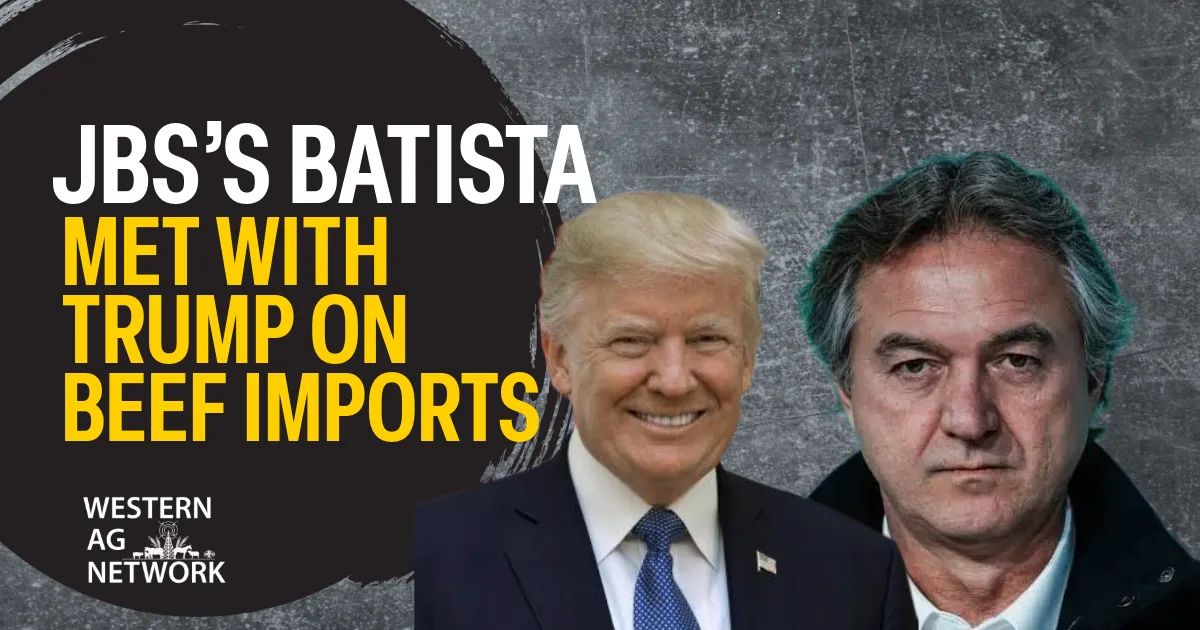
JBS Billionaire Met With Trump Ahead of Tariff-Free Beef Import Move
September 1, 2026 – New reporting is drawing renewed attention to JBS and its ties to the Trump administration after a major shareholder of the Brazilian meatpacking giant reportedly met with President Donald Trump one day before the president announced a temporary expansion of tariff-free beef imports.
According to The Wall Street Journal, Joesley Batista met with Trump at the White House on Aug. 20.
During the meeting, the Journal reports Batista and Trump discussed whether lifting a 26% import duty affecting Brazilian beef could help ease high beef prices in the United States.
It could not be determined who arranged the Oval Office meeting, according to the Journal.
The meeting came one day before Trump announced a temporary expansion of tariff-free beef imports.
In an Aug. 21 post on Truth Social, Trump said the United States would allow up to 300,000 metric tons — approximately 661 million pounds — of beef product intended for ground beef to enter the country over the next 90 days without an out-of-quota tariff.
Trump also said there was a commitment for the imported beef to be sold at 25% below current market prices.
“This deal will reduce prices for Americans while giving space for our Great American Beef Herd to grow again,” Trump said.
The additional volume represents roughly 2% of annual U.S. beef consumption.
The administration has framed the move as an effort to provide consumers relief from historically high ground beef prices while allowing U.S. cattle producers time to rebuild the domestic herd, which remains historically tight following years of drought, high production costs and other challenges.
Cattle organizations, however, quickly raised concerns about the potential impact on cattle markets and herd expansion.
U.S. Cattlemen’s Association President Justin Tupper told Western Ag Network that increasing tariff-free imports could disrupt market signals that are finally encouraging producers to rebuild the U.S. herd.
“We’re finally seeing some profitable times in ranching and signals that would make us make the herd grow,” Tupper said. “Then we see these knee-jerk reactions with the government interfering, and it’s going to have the opposite effect.”
National Cattlemen’s Beef Association CEO Colin Woodall expressed similar concerns, arguing the policy could sacrifice long-term herd rebuilding for short-term price relief.
“Today's announcement and other market interventions throw cold water on the prospect of herd expansion and sacrifices long-term stability for short term messaging,” Woodall said.
Montana Farmers Union President Walter Schweitzer told Western Ag Network that the actual volume of beef involved needs to be put into perspective.
“Three hundred thousand metric tons of beef sounds like a whole bunch, but really, it’s about 2% of U.S. consumption,” Schweitzer said. “It’s going to have an emotional impact. The packers and the buyers are going to utilize this to drive the prices down so they can try to steal more calves from cow-calf producers this fall, when it’s a critical time of sales.”
Schweitzer also argued strong consumer demand is an important factor behind current beef prices and renewed his support for mandatory country-of-origin labeling.
“Quite frankly, because our cow herd is as low as it’s ever been, we need to import beef. I’m not opposed to it, but let’s just put a label on it,” Schweitzer said. “Let’s just put a label on it and give the consumers a chance to pick.”
The Wall Street Journal's reporting on Batista's Aug. 20 meeting adds another layer to the debate.
Brazil is the world's largest beef exporter, and greater access to the U.S. market could benefit Brazilian beef suppliers, including JBS, the world's largest meatpacker and a major player in the U.S. beef industry.
The timing of Batista's meeting does not establish that the JBS executive caused the administration's tariff decision. The Trump administration had already been examining ways to increase beef imports and reduce consumer prices before the Aug. 20 meeting.
Still, the meeting is drawing additional scrutiny because of JBS's growing presence in the United States and its political connections.
Pilgrim’s Pride, the nation's second-largest chicken processor and a company controlled by JBS, contributed $5 million to the Trump–Vance Inaugural Committee, the largest single donation to the inauguration fund.
The contribution, previously reported by Reuters and highlighted by U.S. Sen. Elizabeth Warren, drew scrutiny as JBS was working to expand its presence in U.S. financial markets.
JBS received approval from the U.S. Securities and Exchange Commission in 2025 for its dual-listing plans and began trading in the United States in June 2025.
Warren questioned the timing of the inaugural contribution and JBS's U.S. expansion, raising concerns about potential “pay-to-play” implications.
JBS has said it has long been engaged in civic life and works to provide Americans access to safe and affordable food.
Joesley and Wesley Batista have faced extensive scrutiny over corruption investigations in Brazil.
The brothers acknowledged paying bribes to Brazilian officials and spent time behind bars. JBS and the Batista family have also reached settlements with U.S. authorities stemming from corruption-related matters.
JBS says it has since strengthened its internal compliance and corporate governance systems.
The company has also faced antitrust litigation in the United States. JBS agreed in early 2025 to pay $83.5 million into a settlement fund resolving class-action claims alleging anticompetitive conduct in the U.S. fed-cattle market. The settlement did not constitute an admission of wrongdoing.
The newly reported Aug. 20 meeting is not the first time Batista's discussions with Trump have attracted attention.
Reuters previously reported on a separate meeting between Batista and Trump during heightened trade tensions between the United States and Brazil.
During that encounter, Batista reportedly warned Trump that steep tariffs on Brazilian products, including beef, were contributing to higher prices for U.S. consumers. Sources told Reuters the conversation helped “pave the way” for a warmer tone between Trump and Brazilian President Luiz Inácio Lula da Silva.
The scrutiny surrounding JBS also comes as Trump is publicly criticizing concentration in the U.S. meatpacking industry and calling for farmers and ranchers to have greater ability to process their own livestock.
In a social media post the morning of August 28, 2026, Trump said farmers and ranchers have long raised concerns about the power of the nation's largest processors.
“Ranchers and Farmers have always been my number one priority for me,” Trump wrote. “They work very hard, are smart, efficient, and immaculately CLEAN, but for years I have heard that they have a tremendous problem with the Big Processors, who many say are a nasty monopoly.”
Trump pointed to the four major beef packers, calling four “a very non competitive number” and arguing that consolidation has made life more difficult for agricultural producers.
He also highlighted the foreign ownership of some major processors.
“So, in order to break this powerful monopoly, with much of its ownership based outside of the U.S., I am authorizing legal documents to be drawn in order to allow Farmers and Ranchers to be given the right to PROCESS THEIR OWN FOOD,” Trump wrote.
The announcement adds another element to the debate surrounding the administration's beef policy. JBS, headquartered in Brazil, is one of the four largest beef processors operating in the United States and has a significant presence throughout the U.S. beef supply chain.
Trump's criticism of processor concentration comes as his administration is simultaneously moving to increase tariff-free beef imports — and as new reporting shows a major JBS shareholder discussed Brazilian beef tariffs with the president one day before that import announcement.
For cattle producers, the larger question remains whether increasing imports will lower grocery-store beef prices — and whether doing so could undermine the market signals needed to rebuild domestic cattle supplies.
Sources: The Wall Street Journal, Reuters, Western Ag Network


