.png?fit=outside&w=1200&h=630)
Trump Announces Tariff-Free Beef Imports in Effort to Lower Ground Beef Prices
August 21, 2026
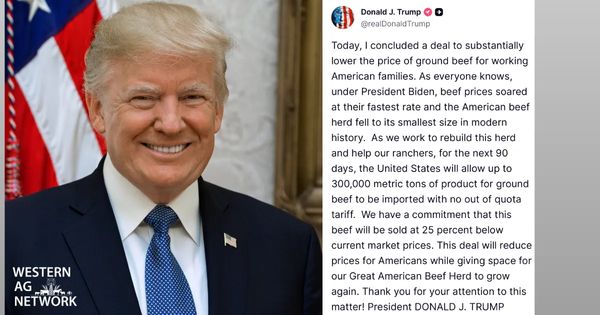
President Donald Trump announced Friday that the United States will temporarily allow additional beef imports to enter the country tariff-free as part of an effort to lower ground beef prices for American consumers.
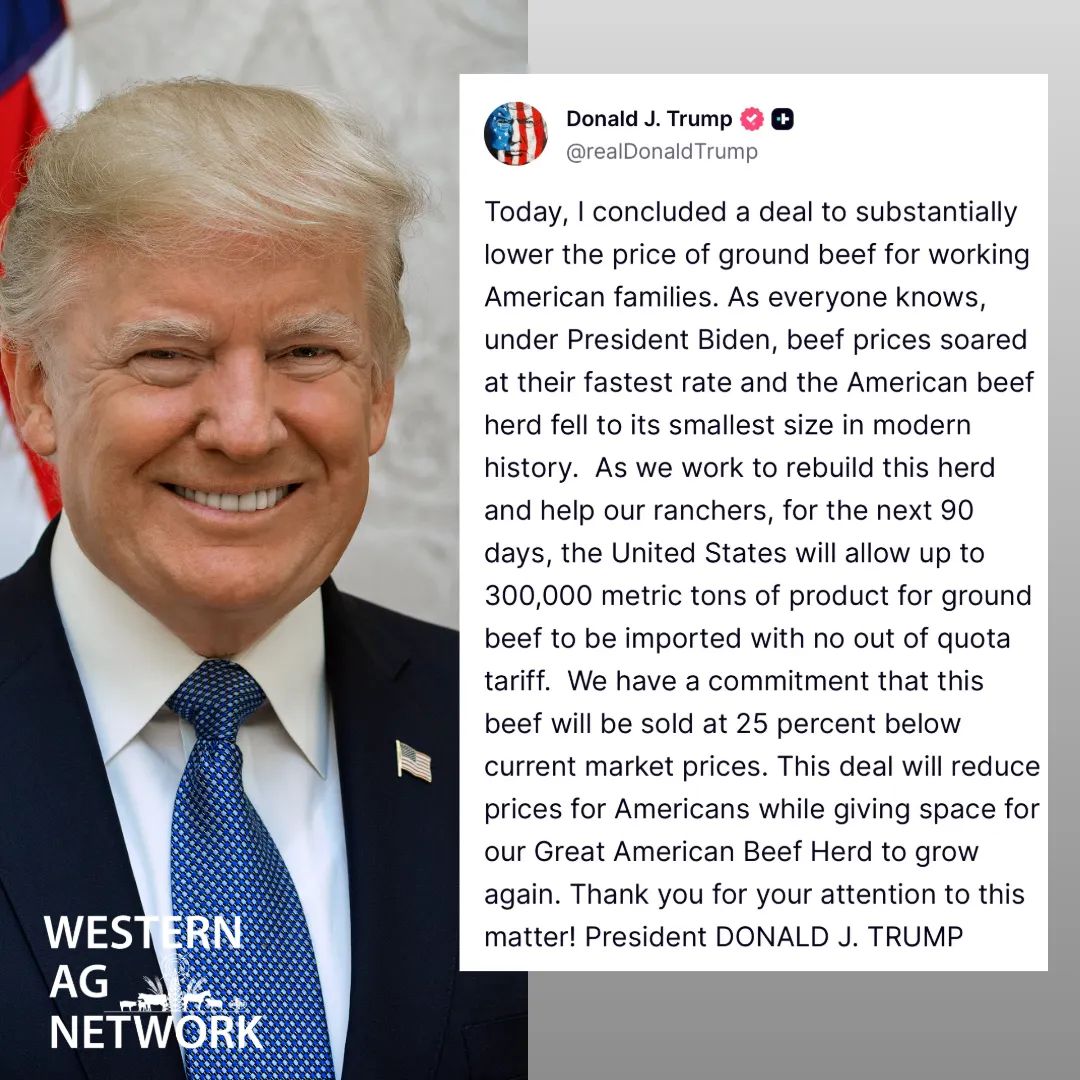
In an Aug. 21 post on Truth Social, Trump said the United States will allow up to 300,000 metric tons of beef product intended for ground beef to be imported over the next 90 days without an out-of-quota tariff.
Trump said there is a commitment for the imported beef to be sold at 25% below current market prices.
“This deal will reduce prices for Americans while giving space for our Great American Beef Herd to grow again,” Trump said.
The announcement comes as the U.S. cattle herd remains historically tight following years of drought, high production costs and other challenges that have contributed to declining cattle inventories.
The announcement is drawing reaction from the U.S. cattle industry.
U.S. Cattlemen’s Association President Justin Tupper told Western Ag Network the administration’s decision to increase tariff-free beef imports could have the opposite effect of what the White House intends by disrupting market signals that have encouraged cattle producers to begin rebuilding the U.S. herd.
“We’ve tried to relay to the White House that it does not have the effect that they hoped it would,” Tupper said. “Anytime you interfere with these markets, the only people that are going to make money are the big packers and the retailers. There’s no guarantee they pass that along to the consumer, and it has a big ripple effect down the chain for the ranchers.”
Tupper said cattle producers are finally seeing prices that could encourage expansion after years of contraction in the U.S. cattle herd.
“We’re finally seeing some profitable times in ranching and signals that would make us make the herd grow,” Tupper said. “Then we see these knee-jerk reactions with the government interfering, and it’s going to have the opposite effect. I think we’ve got to stop interfering with a free market system. Let the market be the market.”
Tupper pointed specifically to recent strength in heifer prices as evidence that producers were beginning to respond to market signals and consider retaining females for breeding.
“For the first time, it was very obvious that the heifer prices—many of them—were bringing more than the steers if they were the good kind to go back to the country,” Tupper said. “There’s the first real big signal that we were trying to rebuild this herd. We’re going to do it, but you can’t make it happen overnight.”
He warned that weakening cattle prices through government intervention could discourage producers from retaining those heifers.
“We’ve got to incentivize these ranchers to keep these heifers, and that means we have to keep good prices or there’s not going to be incentive to do it,” Tupper said. “When they do these things and disincentivize us to keep those heifers, it has the opposite effect of what they’re trying to do.”
Tupper said cattle producers are not asking the government to guarantee high prices, but instead want supply, demand and competition to determine the market.
“We don’t want the government running it. We want a free market system that works,” Tupper said. “Just give us a fair shake. Let competition do its thing, and supply and demand will do it.”
The National Cattlemen’s Beef Association was among the first groups to respond Friday morning. NCBA CEO Colin Woodall said the organization is disappointed with the announcement and raised concerns about the potential impact on cattle markets and efforts to rebuild the U.S. herd.
Woodall said “while America’s cattle producers share the goal of keeping groceries affordable for consumers, flooding the market with government-subsidized, below-market beef is not the way to rebuild the American cattle herd. Cattle markets have already turned sharply lower this morning, to the detriment of farmers and ranchers.”
He pointed out this is a critical time of year for cattle producers, as producers are making decisions regarding their herds and decisionmakers have been responding to strong market signals and historically high demand, and already working to rebuild after years of ongoing drought, high input costs and other challenges that have reduced U.S. cattle numbers.
“Today's announcement and other market interventions throw cold water on the prospect of herd expansion and sacrifices long-term stability for short term messaging,” Woodall said.
Montana Farmers Union President Walter Schweitzer questioned how much impact the additional imports will ultimately have on beef prices, noting that 300,000 metric tons represents a relatively small portion of total U.S. beef consumption.
“Three hundred thousand metric tons of beef sounds like a whole bunch, but really, it’s about 2% of U.S. consumption,” Schweitzer said. “It’s going to have an emotional impact. The packers and the buyers are going to utilize this to drive the prices down so they can try to steal more calves from cow-calf producers this fall, when it’s a critical time of sales.”
Schweitzer said he believes strong consumer demand for beef, rather than simply a shortage of beef in the marketplace, is an important factor behind current prices.
“We’ve got more beef in our supply chain today than we did five years ago. So it isn’t a supply issue that we’re talking about here. It’s demand,” Schweitzer said. “Consumers want to eat beef, and they’re willing to pay for it.”
Schweitzer also used the announcement to renew his support for mandatory country-of-origin labeling, arguing consumers should be able to distinguish imported beef from U.S. beef at the grocery store.
“Quite frankly, because our cow herd is as low as it’s ever been, we need to import beef. I’m not opposed to it, but let’s just put a label on it,” Schweitzer said. “Let’s just put a label on it and give the consumers a chance to pick.”
Western Ag Network will continue to update this story as additional details and reaction from cattle and beef industry organizations become available.
Source: Western Ag Network


