Public Lands Ranchers are Making Their Voices Heard in Colorado
September 17, 2026
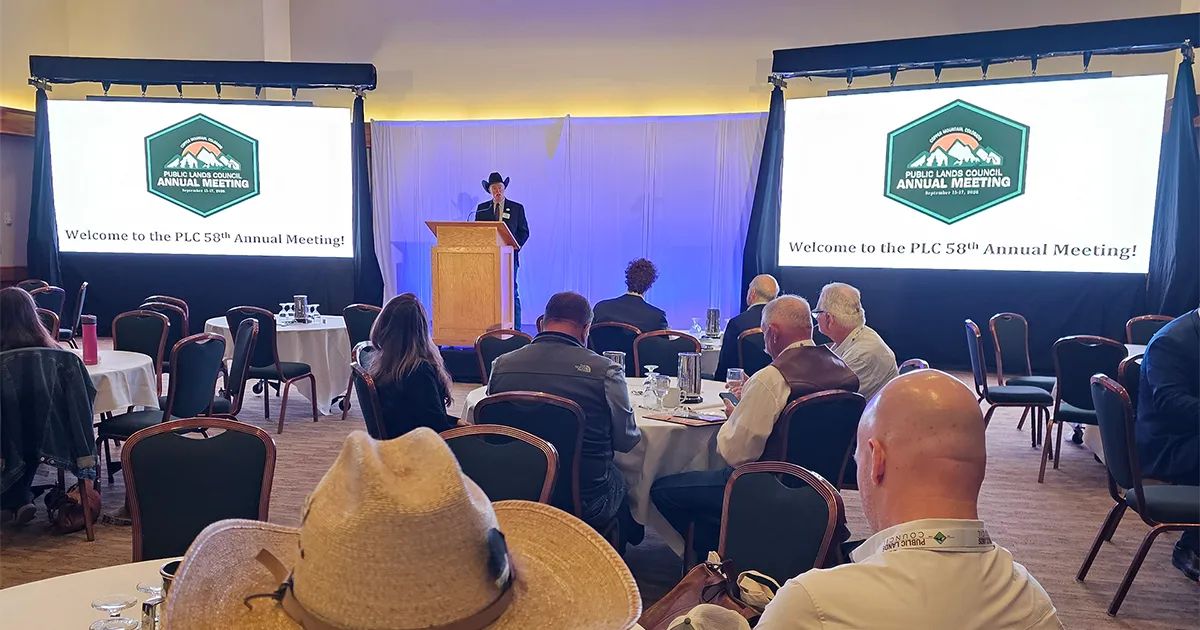
Public lands ranchers from across the West are gathering in Colorado this week for the 2026 Public Lands Council Annual Meeting, where federal grazing policy, land management and the future of ranching on federal lands are taking center stage.
For Public Lands Council President and Colorado rancher Tim Canterbury, the annual meeting is more than a chance for producers to hear from national leaders. He says it is where PLC's grassroots membership determines the organization's direction for the coming year.
“This is where all of our producer members, the grassroots, get to come and set policy that will guide us forward throughout this coming year,” Canterbury said. “This is where it happens.”
Canterbury said the Copper Mountain meeting features a packed agenda and strong producer participation, along with speakers directly involved in federal public lands policy.
Among them is Bureau of Land Management Director Stevan “Steve” Pearce, who was sworn in May 19 as the agency's 20th director. Canterbury said having the New Mexico native and former congressman at the meeting is significant for PLC members.
“This will be the first time we've had a BLM director at a national annual meeting in quite some time, and so we're thrilled to have him,” Canterbury said. “He's been a longtime advocate of agriculture and our industry, and so we're looking forward to hearing from him.”
The meeting comes during a period of significant change in federal public lands policy.
Canterbury pointed to the rescission of the BLM's 2024 Conservation and Landscape Health Rule, often called the Public Lands Rule, as one of the developments PLC has prioritized. The Department of the Interior rescinded that rule in May 2026. BLM has also proposed revisions to federal grazing regulations aimed at streamlining grazing administration and expanding the use of rangeland health standards across agency programs.
Canterbury described those changes as major accomplishments from PLC's perspective.
“Bar none, [that] is the greatest accomplishment that this organization has been able to bring forward,” Canterbury said. “And trust me, it was not me. It was us working collectively.”
Other issues Canterbury said PLC continues to watch include forestry legislation, federal wolf policy and efforts surrounding a new farm bill.
But regardless of which administration controls the White House or Congress, Canterbury said PLC's broader mission remains focused on maintaining livestock grazing as part of the management of federal lands.
“The science is there, Russell,” Canterbury said. “As being stewards of the lands, that's huge. And livestock grazing is a big part of that.”
He said ranchers who live and work on public lands every day have an important role in maintaining working landscapes, and PLC intends to continue making that case to policymakers.
“I don't care what administration is in, the science is there to back up everything we're doing,” Canterbury said. “As long as we keep pushing that forward, it will remain as it is today.”
For Canterbury, that advocacy ultimately comes back to the grassroots producers attending meetings like the one underway at Copper Mountain.
“The real power behind PLC is its grassroots members,” he said. “It's meetings like this right here today over the next several days, where we will have all of our committee meetings and the policy is set.”
Those policies then provide direction to PLC's officer team and staff as they work in Washington and across the West.
“We know our direction. We know what's paramount, number one, for our grassroots folks,” Canterbury said. “And that's what we'll work for the next year.”
The Colorado meeting also carries personal significance for Canterbury as he approaches the end of his tenure as PLC president.
Asked what serving the organization has meant to him and his family, Canterbury said one word immediately came to mind: humility.
“For me to be able to represent as president of National Public Lands Council was a huge, humbling experience,” he said.
Canterbury pointed specifically to opportunities to testify before Congress and represent ranchers whose livelihoods are closely tied to federal lands.
“Knowing that maybe something I had to say would resonate with our senators, our House of Representatives — those are the takeaways that I can pass on for generations,” Canterbury said.
“What a great experience,” he added. “I am totally happy to have had the experience, but very humbled that my fellow producers put me in this position.”
Source: Western Ag Network


