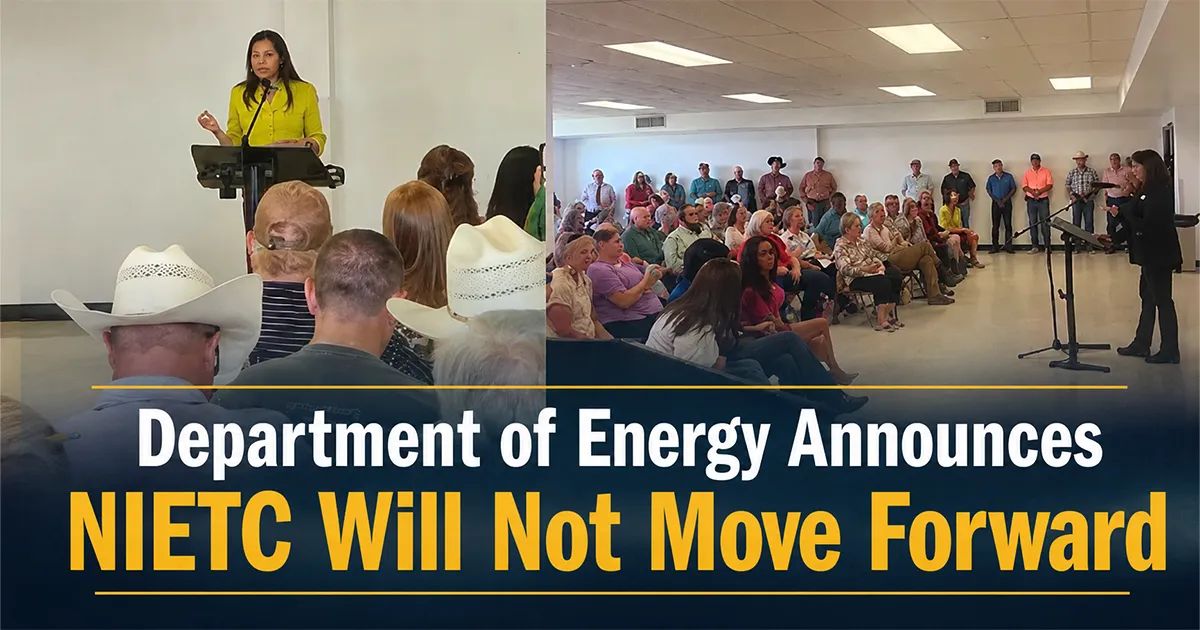
Department of Energy Announces NIETC Will Not Move Forward
August 13, 2026
A large crowd gathered in Lamar, Colo., on August 12 for an announcement regarding the ongoing uncertainty around the National Interest Electric Transmission Corridor or NIETC. The proposed NIETC line map identified more than 2 million acres or 24% of the state of New Mexico and a corridor area in southeastern Colorado ranging from five to 15-miles wide across Prowers, Baca and Kiowa counties. All told, affected areas contribute $1.9 billion in New Mexico annually and another $504 million annually in the three affected Colorado counties just from agriculture production. Landowners have sought the help of U.S. Sec. of Agriculture Brooke Rollins but help arrived from the Department of Energy’s Office of Electricity Assistant Secretary Katie Jereza.
“Today, the DOE is announcing that we do not plan to move forward with designating the three proposed national interest electric transmission corridors, or NIETC,” she announced.
Jereza said a consistent message emerged during the planning of the NIETC projects.
“There was not a broad public support for designating these NIETCs, the framework was not working for Colorado, New Mexico, and Oklahoma,” she said. “In other communities across the country where these corridors were proposed, the process created uncertainty rather than confidence.”
She said the agency heard concerns about landowners and property rights and the effects of the designations of working lands, ranching operations, agricultural production, and local planning. She said she heard this from agricultural, conservation, and landowner organizations, including farmers, ranchers, tribes, states, and local government.
“Their voices remind us of the deep connection communities have to their land,” she said. “We must keep our attention on the multigenerational land that hardworking farmers and tribal members have cultivated and prospered from for centuries. Their deep connections to the land and the cultural and economic interests that are tied to it underscore why meaningful community engagement must remain central to transmission planning.”
She said federal intervention for NIETCs must be reserved for circumstances that clearly serve the national interest and where the need for that intervention is supported by the facts.
“Additionally, there was a lack of expressed interest from developers interested in seeking federal backstop authority through the NIETC process,” she said. “Developers generally indicated a preference for working with state and local permitting frameworks, highlighting the importance of approaches that are responsive to local needs and priorities. As we look ahead, we recognize the importance of considering the full range of tools available to address transmission constraints and congestion, such as advanced transmission technologies, grid-enhancing technologies, and new generation resources.”
She said announcements of projects funded by SPARK, Speed to Power through Accelerated Reconductoring and other Key Advanced Transmission Technology Upgrades, will be announced in the coming weeks. The $1.9 billion is earmarked to accelerate urgently needed upgrades to the nation’s power grid and reduce consumer energy costs.
The SPARK opportunity builds on the Grid Resilience and Innovation Partnerships (GRIP) Program, which provided up to $10.5 billion in competitive funding over five years to states, tribes, electric utilities, and other eligible recipients to strengthen grid resilience and innovation. The previous two GRIP funding rounds covered FY 2022-2023 and FY 2023-2024 funding. Today’s announcement continues the mission of the GRIP Program under the SPARK funding opportunity, focusing on the rapid deployment of reconductoring and other ATTs that expand transfer capability, strengthen reliability and resource adequacy, and reduce costs for consumers, all while making use of existing rights of way.
The cancellation encompasses the Southwestern Grid Corridor, including parts of Colorado, New Mexico, and Oklahoma; the Lake Erie/Canada Corridor, covering parts of Lake Erie and Pennsylvania; and the Tribal Energy Access Corridor, covering parts of North and South Dakota, Nebraska, and five tribal reservations.
Source: Western Ag Network-Rachel Gabel
Photos by Josh Langworthy (left) and Clare Dunn (right)


